Asphalt Paving Blog

How Soil Stabilization or Rebasing Helps Your Parking Lot or Driveway

Posted by Riley Stendel on Apr 2, 2013

Here at Wolf Paving, we care about ensuring our work is the very best it can be and that it lasts as long as possible. To achieve the best results, we carefully consider every aspect of a paving project, literally from the ground up. What kind of soils exist at the site? If paving has been done before, what materials were used and are they re-usable in the current project? We ask these questions because we know an excellent base is required for an excellent result. A weak base could result in the pavement above it shifting, cracking, or even sinking. 

Asphalt Pulverizing - An Asphalt Recycling Process

Posted by J. Mrugacz on Mar 26, 2013

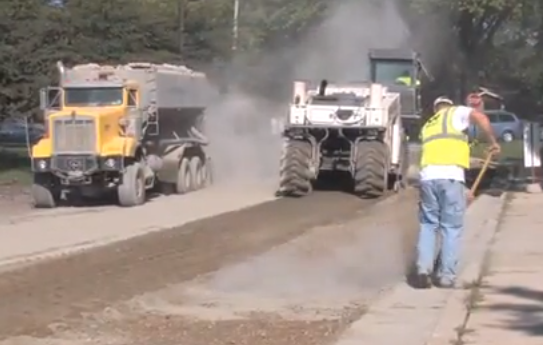
How do you keep roads and parking lots in good condition cost-effectively?  We’ve already talked about many of our routine maintenance suggestions, such as filling in cracks and sealcoating, but sometimes a surface is too damaged for these small actions – in these cases, it would take more money and time to repair than it would to perform a full rehabilitation.  But asphalt pulverizing offers a very economical way to fully rehabilitate a road or lot with minimal traffic disruption. It’s also a great way to save on paving materials. 

What is pulverization?

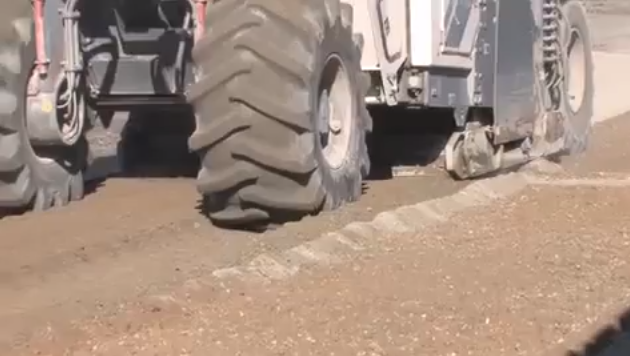
Pulverizing is a process that grinds up existing surface layers right in place, blending the asphalt layers with any sub-layers, essentially creating a new paving mix using all the old materials. No pavement is hauled away, saving costs on excavating and trucking, and rarely does new material have to be brought in (though sometimes additives or a new overlay are suggested).  Asphalt pulverizing solves most common problems, such as severe cracking and sharp edges created by continuous traffic (called “polishing”). 

5 Benefits of Using Perpetual Pavement

Posted by J. Mrugacz on Mar 19, 2013

Perpetual pavement is a flexible but strong asphalt pavement that doesn't exhibit structural damage even when very high traffic flows over long periods of time. They’re made up of multiple layers of durable asphalt. The bottom layer is designed to be strong but flexible to resist strains that could cause cracks to form from the bottom up. A similar intermediate layer adds additional structural protection, and the final layer, made of rut-resistant hot-mix asphalt (HMA), requires only minimal maintenance. 

These surfaces have been around a long time. Some of the oldest perpetual pavements have been around since before the 1960s. The surfaces created then that were well designed and executed have provided very long usefulness without much maintenance even with heavy traffic. These days, advancements in milling, recycling, and asphalt production technologies make it even more likely that perpetual pavements will perform better and longer.

The Process Behind Asphalt Milling

Posted by Riley Stendel on Mar 12, 2013

One interesting part of the asphalt process that you might not be aware of happens before any asphalt is laid. It’s called asphalt milling.

What is asphalt milling?

Milling is the process of removing the top layer of asphalt to a specified and even depth without disturbing the underlying subbase. This allows new asphalt to be laid down without increasing the height of the road and saves you time if the subbase doesn't need to be fixed. Thanks to the milling process curbs, drainage and other existing structures remain undisturbed.

The Differences of Pervious, Permeable, and Porous Asphalt

Posted by J. Mrugacz on Feb 25, 2013

Have you ever felt like the terminology of a subject strands you in an unknown land?  Take asphalt -- if you’re just learning about it, terminology can be a barrier.  Those in the industry don’t think twice about terms like “hot-mix” or “sealcoating,” but for the layman, these can be confusing.

Pervious and Permeable and Porous, Oh My! 

Some terms that often get mixed up are pervious, permeable, and porous.  These sound similar, like they all mean the same thing.  In fact, if you look up “pervious,” “permeable” is part of the definition!  Both mean a substance that allows liquids or gases to pass through (as opposed to being a solid barrier).  These terms are also used synonymously in asphalt. Pervious or permeable pavements have connected spaces that allow water to percolate through the surface. 

“Porous” has a similar, but slightly different, meaning.  Holes or spaces in the surface allow water in, but these are not necessarily connected.  While fluids could get in, they have nowhere to go from there and can't easily percolate down to the water table.  This distinction, however, is not generally recognized in the industry.